The Trades Behind AI Infrastructure
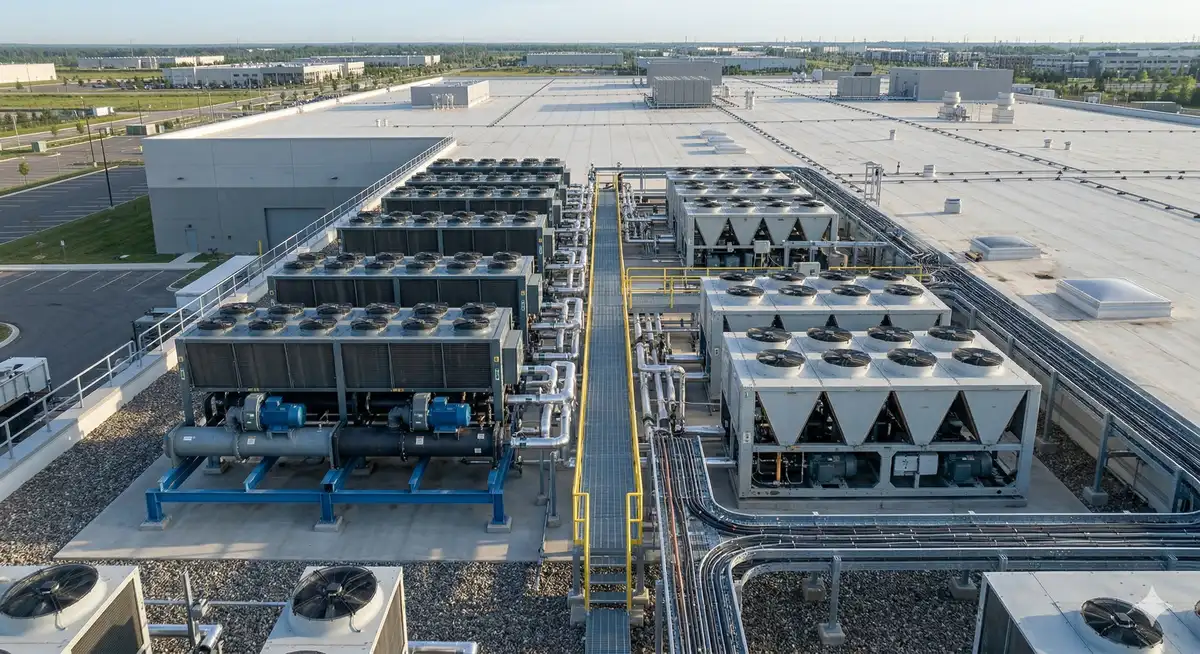
AI facilities need HVAC technicians, electricians, controls engineers, and mechanical specialists alongside software teams. These roles build and maintain the power and cooling systems on which compute capacity depends.
The workforce data shows where demand is growing. According to Randstad's 2026 workforce analysis, demand for HVAC engineers in the data center sector has surged 67% since 2022. Robotic technician demand has exploded by 107% in just four years. Electrician demand is up 18% and accelerating. Across the board, skilled trades demand in data center construction and operations is growing three times faster than professional and technical roles. Three times. While everyone is fighting over a shrinking pool of software engineering positions increasingly threatened by AI code generation tools, the physical infrastructure layer is starving for talent.
This is not a peripheral concern. This is the central constraint on the entire AI industry's growth trajectory. Sander van 't Noordende, CEO of Randstad, put it bluntly in the company's 2026 workforce report: "The real constraint on global tech growth isn't chips, energy, or capital — it's specialized talent." Larry Fink, CEO of BlackRock, the world's largest asset manager, has been even more direct. At multiple investor conferences in 2025, Fink stated plainly: "We're going to run out of electricians." BlackRock is deploying $100 billion into AI infrastructure and they are telling the world that the binding constraint is not capital — it is electricians. Brad Smith, President of Microsoft, has called electrical talent the "single biggest challenge" facing data center buildouts.
"The real constraint on global tech growth isn't chips, energy, or capital — it's specialized talent."— Sander van 't Noordende, CEO, Randstad (2026 Workforce Report)
I have watched this unfold in real time. Every major data center operator I work with — hyperscalers, colocation providers, enterprise operators — is facing the same problem. They can secure the land. They can obtain the power. They can finance the builds. But they cannot find enough qualified HVAC technicians, electricians, controls engineers, and mechanical specialists to actually construct and operate these facilities. The pipeline that feeds skilled trades into the data center industry has been neglected for decades, and now the bill is coming due just as AI is creating the largest infrastructure buildout since the interstate highway system.
From the Floor: What I See Every Day
In my facility, it takes an average of 4.2 months to fill an MEP (Mechanical, Electrical, Plumbing) engineering vacancy. Five years ago, it was 6-8 weeks. The candidates we do get are either fresh out of trade school with zero critical facilities experience, or they are retirement-age veterans who learned their craft in an era before liquid cooling, GPU clusters, and 50MW+ campuses existed. The middle of the talent pipeline — experienced professionals in their 30s and 40s who should be the backbone of our operations teams — barely exists. They went into other industries during the years when data centers were not hiring aggressively, and they are not coming back easily.
Data Center Workforce Demand
The scale of the data center workforce gap becomes starkly apparent when you look at the employment trajectory. In 2016, total U.S. data center employment stood at approximately 306,000 workers across construction, operations, and support roles. By 2023, that number had climbed to 501,000 — a 64% increase driven by cloud migration, streaming services, and the early stages of AI workload deployment. Current projections from the Bureau of Labor Statistics and industry analysts put the 2026 figure at approximately 650,000, with an additional 340,000 unfilled positions that operators simply cannot staff.
The Uptime Institute's 2025 Global Data Center Survey provides the most authoritative snapshot of this crisis. Their findings are sobering: 65% of data center operators report significant difficulty finding and retaining qualified technical staff. This is not a marginal increase — it represents a structural inability to staff critical infrastructure. The same survey found that the problem is worsening year over year, with operators reporting that both recruitment timelines and training requirements are increasing simultaneously. Facilities are being built faster than the workforce can grow to operate them.
But the demand side is only half the crisis. The supply side is collapsing simultaneously. The average age of an experienced data center mechanical or electrical engineer in the United States is approximately 60 years old. According to workforce analytics from Uptime Institute and corroborated by industry HR data, 32% of the current U.S. data center engineering workforce is over 60, while only 16% is under 30. The industry is staring down a generational cliff. An estimated 23,000 experienced data center workers retire annually, and 33% of the total U.S. data center workforce was projected to retire by 2025. This is the "silver tsunami" that industry insiders have been warning about for a decade — and it is hitting at precisely the moment when AI is demanding the largest infrastructure expansion in the sector's history.
The Silver Tsunami Meets the AI Boom
The collision of mass retirement and unprecedented demand creates a compounding crisis. Every retiring engineer takes 20-30 years of institutional knowledge about specific facility quirks, failure modes, and operational procedures. That knowledge cannot be replaced by hiring a fresh graduate. The industry needs approximately 340,000 new workers by end of 2026, while simultaneously losing 23,000 experienced workers per year to retirement. The math does not work — and the gap is widening, not closing.
The vacancy data paints an equally grim picture at the role level. MEP engineer positions — the mechanical, electrical, and plumbing specialists who are the backbone of any critical facility — take an average of 4.2 months to fill. Critical facilities engineers, the senior technical leaders who oversee entire facility operations, can take six months or longer to recruit. These are not niche roles. These are the people who keep the servers running, the cooling systems operating, and the power flowing. Every unfilled position represents increased risk for the facility, higher workload for remaining staff, and potential delays in bringing new capacity online.
| Year | DC Employment (U.S.) | YoY Growth | Unfilled Positions | Key Driver |
|---|---|---|---|---|
| 2016 | 306,000 | — | ~45,000 | Cloud migration begins |
| 2018 | 358,000 | +8.5% | ~72,000 | Hyperscale expansion |
| 2020 | 398,000 | +5.6% | ~110,000 | Pandemic digitization |
| 2022 | 452,000 | +6.8% | ~165,000 | Edge + early AI workloads |
| 2023 | 501,000 | +10.8% | ~210,000 | Generative AI surge |
| 2026 (proj.) | 650,000 | +9.5%/yr | ~340,000 | AI factory buildout |
The demographic breakdown reveals a structural problem that cannot be solved with short-term recruiting pushes. The data center industry failed to attract younger workers during the 2010s because it was perceived as a niche sector with limited career growth. Meanwhile, competing industries — oil and gas, commercial HVAC, residential construction, manufacturing — absorbed the trade school graduates and apprenticeship completers who might otherwise have entered data center operations. Now the industry is competing fiercely for the same limited talent pool, but it is doing so with a 15-year hiring deficit and an aging workforce that is heading for the exits. Without a fundamental restructuring of the talent pipeline — including training programs, apprenticeships, and radically different recruiting strategies — this crisis will constrain the AI infrastructure buildout for the rest of the decade.
Six-Figure Careers Without a Four-Year Degree
Here is the part that should be making headlines: data center skilled trades roles are some of the best-compensated jobs in the infrastructure sector, and the vast majority do not require a four-year college degree. The compensation data from 2024 and 2025 industry surveys reveals a career path that goes from entry level to six figures in three to five years — faster than most white-collar professional tracks, and without the student debt.
The salary landscape has shifted dramatically due to AI-driven demand. Data center technician compensation jumped 43% in just three years, from 2022 to 2025, as operators competed aggressively for scarce talent. According to the Uptime Institute's 2024 compensation survey, 77% of data center professionals received salary increases in 2024, with the median increase exceeding typical cost-of-living adjustments by a significant margin. Data center construction workers earn 25-30% more than their counterparts in equivalent non-DC roles in commercial or industrial construction, reflecting the specialized skills and reliability requirements of critical infrastructure work.
| Role | Experience Level | Salary Range | Degree Required? |
|---|---|---|---|
| DC Technician | Entry (0-2 yrs) | $38,000 – $57,000 | No — trade cert or apprenticeship |
| DC Technician | Mid-Level (2-5 yrs) | $68,000 – $84,000 | No — experience + certs |
| DC Technician | Senior (5-10 yrs) | $105,000 – $142,000 | No — certs + track record |
| Facilities Engineer | Mid-Level | $75,000 – $115,000 | AAS or equivalent experience |
| DC Engineer | Mid to Senior | $92,000 – $141,000 | AAS or BS preferred, not required |
| Liquid Cooling Specialist | Specialist | $90,000 – $160,000 | No — HVAC + specialized training |
| AI Infrastructure Specialist | Senior Specialist | $140,000 – $200,000 | No degree required — deep expertise |
| DC Director | Leadership | $187,000+ | Varies — experience-driven |
The standout trend in this data is the emergence of premium specialist roles that did not exist five years ago. Liquid cooling specialists — professionals who understand direct-to-chip liquid cooling, rear-door heat exchangers, immersion cooling, and the associated plumbing, chemistry, and control systems — are commanding $90K to $160K. That is a 35-90% premium over traditional HVAC technicians doing equivalent-complexity work in commercial buildings. The reason is straightforward: every new AI-class data center being built today requires some form of liquid cooling, and the number of people who actually understand how to install, commission, and operate these systems at scale is vanishingly small.
AI infrastructure specialists sit at the very top of the technical ladder. These are the people who understand not just the mechanical and electrical systems, but the interplay between GPU cluster performance, thermal management, power distribution, and network topology. They can look at a rack of NVIDIA DGX systems pulling 40kW and understand why the cooling system is struggling, why the PDU is alarming, and how the airflow pattern needs to change to support the next-generation hardware. Their compensation reflects this cross-domain expertise: $140K to $200K, and these roles are almost impossible to fill because the combination of deep mechanical/electrical knowledge and AI workload understanding is extremely rare.
The Degree Myth
Notice what is absent from the "Degree Required?" column: mandatory four-year degrees. In data center operations, certifications, apprenticeship completion, and demonstrated hands-on competence carry far more weight than a bachelor's degree. An HVAC journeyman with a CDCTP certification and three years of critical facilities experience will be hired over a BS in Mechanical Engineering graduate with no operational background, every single time. The industry values what you can do over what piece of paper you hold. This is one of the last remaining high-compensation career paths where meritocracy genuinely prevails.
The Skills That Actually Matter
The skills landscape for data center operations is bifurcating into two categories: the foundational trades skills that have always been essential, and the emerging AI-era specializations that are creating entirely new career tracks. Understanding both is critical for anyone planning to enter or advance in this field, because the highest-compensated roles increasingly require proficiency across both categories.
The foundational skills remain non-negotiable. HVAC systems — including chillers, cooling towers, CRAHs (Computer Room Air Handlers), CRACs (Computer Room Air Conditioners), economizer systems, and hot/cold aisle containment — are the backbone of every data center. Electrical systems knowledge — medium-voltage switchgear, transformers, UPS systems, PDUs, automatic transfer switches, and generator plants — is equally essential. Mechanical aptitude covering plumbing, piping, pumps, and fire suppression systems (FM-200, Novec 1230, pre-action sprinkler) rounds out the traditional skill set. Building Management Systems (BMS) and EPMS (Electrical Power Monitoring Systems) proficiency ties it all together, because modern data centers are highly instrumented and operators must be fluent in reading and responding to the data these systems generate.
But the AI era is layering entirely new skill requirements on top of this foundation, and the premium these skills command in the labor market reflects their scarcity. Liquid cooling — encompassing direct-to-chip cold plates, rear-door heat exchangers, single-phase and two-phase immersion cooling, and the associated coolant distribution units (CDUs) — is the most immediate new skill. Every NVIDIA GB200 NVL72 rack is designed for liquid cooling. Every major hyperscaler's next-generation AI cluster requires it. Yet the number of technicians who have actually installed, commissioned, and operated production-scale liquid cooling systems is a fraction of what the industry needs.
| Skill Category | Traditional Skills | AI-Era Skills | Salary Full access |
|---|---|---|---|
| Cooling | HVAC, chillers, CRAHs, economizers | Liquid cooling, immersion, CDUs | +35-90% over traditional HVAC |
| Electrical | MV switchgear, UPS, PDU, generators | Grid interconnection, HV DC, battery storage | +20-40% over commercial electrical |
| Mechanical | Piping, pumps, fire suppression | GPU cluster management, rack-level thermal | +25-50% with AI cluster experience |
| Controls | BMS, EPMS, SCADA basics | AI-driven BMS, predictive maintenance, DCIM | +30-60% with advanced controls |
| Compliance | Safety, codes, maintenance logs | ESG reporting, carbon accounting, water usage | +15-25% with sustainability certs |
GPU cluster management is another emerging skill set that barely existed three years ago. Understanding how to physically deploy, cable, and maintain racks of NVIDIA H100, H200, or B200 systems — including NVLink interconnects, InfiniBand cabling, high-density power connections, and the thermal monitoring specific to AI accelerators — is a specialized competency that operators are scrambling to develop. The technician who can troubleshoot why a specific GPU in a DGX system is throttling due to a cooling flow imbalance, or why an InfiniBand link is degrading because of a cable bend radius violation, is worth their weight in gold.
Grid interconnection and high-voltage electrical work represent perhaps the most supply-constrained skill set. As AI data centers push to 100MW, 500MW, and even gigawatt-scale campuses, they require dedicated substation construction, transmission line work, and complex utility interconnection agreements. The electricians and lineworkers who can build and maintain this infrastructure are pulled from the same labor pool that is simultaneously building solar farms, wind installations, battery storage facilities, and EV charging networks. The competition for high-voltage electrical talent is intense and will remain so for the foreseeable future.
The critical certification pathways that employers value most include: BICSI Installer Level 1 and 2 for structured cabling and infrastructure; OSHA 10 and 30 for occupational safety; CompTIA ITF+ as a foundational IT certification; and the Uptime Institute CDCTP (Certified Data Center Technical Professional), which has become the industry's gold standard for operations competency. The CDCTP in particular carries significant weight because it validates both theoretical knowledge and practical understanding of data center operations across all disciplines. Specialists often add vendor-specific certifications from Schneider Electric, Vertiv, or Eaton to demonstrate proficiency with specific equipment platforms deployed in their facilities.
The Human-Machine Shift
The most important meta-trend in data center skills is the shift from "performing tasks" to "directing how machines perform them." AI-driven predictive maintenance systems, autonomous BMS optimization, and robotic inspection platforms are not replacing data center technicians — they are changing what technicians do. The next generation of DC operators will spend less time turning wrenches and more time interpreting sensor data, programming automation sequences, managing robotic systems, and making complex decisions that machines cannot. This is why robotic technician demand is up 107% — the industry needs people who can work alongside and manage intelligent systems, not people who will be replaced by them.
Where the Jobs Are
Data center jobs are not uniformly distributed across the country. The geography of AI infrastructure construction follows power availability, land costs, fiber connectivity, and regulatory environment — and right now, several regions are experiencing an absolute boom in DC-related employment. Understanding where the jobs are concentrated is essential for anyone making career decisions in this space, because relocation to a hotspot market can double your starting salary and accelerate your career progression by years.
Northern Virginia — specifically the Ashburn-to-Manassas corridor in Loudoun and Prince William counties — remains the undisputed epicenter of data center employment worldwide. Often called "Data Center Alley," this region hosts the highest concentration of data centers on the planet, with 523 MW of new capacity currently under construction or in advanced permitting stages. That 523 MW translates to approximately 3,200+ construction jobs and 800+ permanent operations positions. The average data center technician salary in Northern Virginia runs 15-20% above the national average, reflecting both the concentration of employers competing for talent and the high cost of living in the greater Washington, D.C. metropolitan area.
Phoenix, Arizona has emerged as the fastest-growing data center market in the country. The combination of relatively affordable land, abundant solar energy potential, favorable tax incentives, and a pro-development regulatory environment has attracted massive investments from Microsoft, Google, Amazon, and Meta. The Phoenix metro area — particularly the Goodyear, Mesa, and Chandler submarkets — is seeing a construction boom that is creating thousands of skilled trades jobs. Water availability remains the primary constraint, but the industry's shift toward air-cooled and liquid-cooled designs for AI workloads is partially mitigating this concern.
Dallas-Fort Worth, Atlanta, and Chicago round out the top five U.S. data center employment markets. DFW benefits from low power costs, central geographic location, and a strong existing trades workforce from the oil and gas sector. Atlanta's strength comes from its position as a fiber connectivity hub and a growing tech talent pool from Georgia Tech and other regional universities. Chicago leverages its role as a financial services and enterprise computing center, with significant existing data center inventory that requires ongoing operations staff.
Northern Virginia (Ashburn)
World's largest DC cluster. 523 MW under construction. Highest concentration of operators including AWS, Microsoft, Google, Equinix, Digital Realty, QTS, and dozens more. Full access salaries with high cost of living.
Phoenix, AZ
Fastest-growing market. Major investments from all hyperscalers. Favorable tax environment and abundant solar energy. Lower cost of living than Virginia. Growing rapidly from a smaller base.
Dallas-Fort Worth, TX
Low power costs, central location, and a strong existing trades workforce. Oil and gas sector provides experienced electrical and mechanical talent transitioning into DC operations.
The hiring scale of individual companies underscores the magnitude of this opportunity. Equinix, the world's largest colocation provider, had 837 open positions listed on their careers page in Q1 2026, spanning construction, operations, engineering, and project management. Amazon Web Services, Google Cloud, Microsoft Azure, and Meta Platforms each maintain hundreds of open data center roles at any given time. The combined AI infrastructure capital expenditure from these four companies alone exceeded $400 billion in 2025 committed spending, and every dollar of that capex eventually translates into construction jobs and permanent operations positions.
Second-tier cities are emerging as significant employment opportunities as well. Markets like Columbus (Ohio), Salt Lake City, Reno, Portland, and central Indiana are attracting data center investment as primary markets reach power and land constraints. These secondary markets often offer an attractive combination of lower cost of living, strong community college systems that can produce trained workers, and less competition for skilled trades talent. For someone entering the data center workforce, starting in a secondary market and building experience before moving to a primary market is a viable and increasingly common career strategy.
The construction pipeline alone tells the employment story. According to Associated Builders and Contractors, the data center construction sector needs 349,000 net new construction workers in 2026 alone — and that is on top of replacing the approximately 160,000 construction workers who leave the industry annually due to retirement, injury, or career changes. These are not temporary gig positions. Data center construction projects typically run 18-36 months, with many workers transitioning directly from construction into permanent operations roles at the facilities they helped build.
How to Get In — Training Programs
The most common question I receive from people interested in data center careers is some variation of: "How do I start? I don't have a degree, I don't have experience, and I don't know where to begin." The good news is that the industry has recognized its workforce crisis and is investing heavily in training programs, apprenticeships, and certification pathways that can take someone from zero to employed in as little as six to twelve months. The entry path is real, it is accessible, and it leads to six-figure earning potential within three to five years. Here are the programs that actually produce job-ready candidates.
Northern Virginia Community College (NOVA) launched the first fully accredited Associate of Applied Science (AAS) degree in Data Center Operations in partnership with Amazon, Microsoft, and other industry employers. This two-year program covers electrical systems, mechanical systems, IT fundamentals, and data center-specific operations, with significant hands-on lab time in purpose-built training facilities. Graduates from the first cohorts reported near-100% placement rates, with starting salaries averaging $45K-$55K. NOVA's program has become the template that community colleges across the country are now replicating.
Microsoft Datacenter Academy is one of the most accessible entry points into the industry. The program provides hands-on internship experience in Microsoft's operational data centers, combining classroom training with practical work alongside experienced technicians. Participants earn industry-recognized certifications during the program, and Microsoft has committed to hiring a significant percentage of graduates into full-time roles. The academy specifically targets veterans, career changers, and underrepresented communities, and does not require any prior technical experience.
Google's Workforce Development program offers an 18-month apprenticeship model that is widely considered one of the best in the industry. Apprentices split time between classroom instruction and supervised on-the-job training in Google's data centers, earning a salary throughout the program. Google's approach emphasizes the full stack of data center operations — from physical infrastructure to basic IT systems — producing graduates who understand both the facilities and the technology they support. The 18-month duration allows for deep skill development that shorter programs cannot match.
Amazon Career Choice includes an IT Infrastructure Specialist training track that is available to Amazon employees and external candidates. The program covers core data center competencies and provides a pathway from warehouse or logistics roles into technical positions in Amazon's data center operations. For someone already working at Amazon in a non-technical role, Career Choice represents an internal mobility opportunity that can dramatically increase earning potential without leaving the company.
NOVA Community College
First accredited AAS in Data Center Operations. Two-year program with hands-on labs. Industry partnerships with Amazon, Microsoft. Near-100% placement rate for graduates.
Microsoft Datacenter Academy
Hands-on internships in operational DCs. Earn industry certifications. Targets veterans and career changers. No prior technical experience required. Strong hire-through rate.
Google Apprenticeship
18-month paid apprenticeship. Classroom + hands-on in Google DCs. Full-stack operations training covering facilities and IT systems. Considered one of the industry's best programs.
BlackRock Future Builders represents the most significant private-sector investment in data center workforce development. BlackRock has committed $100 million over five years to train 50,000 workers for data center and AI infrastructure roles. The program funds training partnerships with community colleges, trade schools, and union apprenticeship programs across the country. The scale of this commitment reflects BlackRock's assessment — as the world's largest asset manager deploying over $100 billion into AI infrastructure — that workforce development is not a corporate social responsibility initiative but a critical investment prerequisite. If the workers do not exist, the infrastructure cannot be built, and the capital returns evaporate.
Equinix Military SkillBridge is specifically designed for transitioning service members in their final 180 days of active duty. The Department of Defense SkillBridge program allows service members to participate in industry training and internships while still receiving military pay and benefits. Equinix's program provides data center operations training and fast-tracks participants into full-time roles. Military veterans bring disciplined work habits, experience with complex systems, comfort with shift work, and security clearance eligibility — all attributes that data center operators value highly.
The Uptime Institute CDCTP certification deserves special mention as the single most valuable credential a data center professional can obtain. The Certified Data Center Technical Professional program validates competency across all domains of data center operations: power, cooling, fire suppression, monitoring, maintenance procedures, and safety protocols. The CDCTP is vendor-neutral, internationally recognized, and carries significant weight with employers. Many operators list it as a preferred or required qualification for mid-level and senior technical roles. The certification can be obtained through self-study and examination, making it accessible to working professionals who cannot take months off for a formal program.
The Realistic Entry Path
Here is the realistic career timeline I advise anyone entering this field to plan for: Months 1-6: Obtain OSHA 10, CompTIA ITF+, and BICSI Installer Level 1 certifications while applying to entry-level DC technician or apprenticeship roles. Months 6-12: Start working entry-level at $38K-$57K, building hands-on experience. Years 1-3: Pursue CDCTP certification, specialize in a domain (electrical, mechanical, or controls), advance to mid-level at $68K-$84K. Years 3-5: Develop AI-era specializations (liquid cooling, GPU systems), target senior roles at $105K-$142K+. This is not a theoretical path — I have watched dozens of people follow it successfully in my own facilities.
A Day in the Life — What DC Engineers Actually Do
I have spent twelve years walking data center floors, and I can tell you that no job description or training manual captures what this work actually feels like. The reality is simultaneously more mundane and more intense than outsiders imagine. Most of your shift is routine — methodical inspections, documentation, monitoring dashboards. Then, without warning, everything changes. A breaker trips, an alarm cascades, a chiller compressor seizes, and suddenly you are the only thing standing between a $200 million facility and a catastrophic outage. Understanding what a typical shift looks like is essential for anyone considering this career, because the daily rhythm of data center operations is unlike any other engineering discipline.
Every shift begins with handover. You arrive at least 15 minutes early to overlap with the outgoing team. The night shift engineer walks you through the shift log — every alarm that fired, every maintenance activity completed, every anomaly observed. You review the BMS (Building Management System) dashboards for any trending issues: is Chiller 3 running at higher-than-normal head pressure? Has the UPS battery string in Hall B shown any cell voltage drift? Are any environmental sensors in the hot aisle approaching the ASHRAE A1 upper limit of 35°C? This handover is sacred. In critical infrastructure, the most dangerous moment is the transition between shifts, when institutional awareness of facility state transfers from one brain to another. Sloppy handovers cause outages — I have seen it happen.
After handover, you conduct a facility walkdown. This is a physical inspection of every major system — electrical switchgear rooms, UPS halls, generator yards, chiller plants, cooling distribution units (CDUs), and the white space itself. You are looking for things that sensors cannot detect: oil stains under a transformer, a slightly unusual vibration in a pump bearing, a cable tray that is sagging under added weight, condensation on a chilled water pipe indicating insulation failure. A good engineer develops an intuitive sense for their facility — you can hear when a fan is running off-balance, smell when an electrical connection is overheating, feel when a floor tile is warmer than it should be. These walkdowns typically cover 10,000+ steps across facility floors, and you will spend time in hot aisle environments reaching 35–45°C, as well as near generators producing 85+ dB of noise that requires hearing protection.
Planned maintenance consumes the bulk of most shifts. Every task is governed by a Method of Procedure (MOP) — a step-by-step document that has been reviewed, approved, and rehearsed before execution. A typical MOP for switching a UPS to static bypass for battery replacement might be 40 steps long, with hold points requiring supervisor sign-off before proceeding. You execute MOPs for draining and refilling chiller glycol loops, testing generator auto-start sequences (verifying start-to-load transfer within 10 seconds), replacing CRAH (Computer Room Air Handler) fan assemblies, re-torquing electrical bus connections, calibrating temperature and humidity sensors, and testing fire suppression system activation circuits. Every MOP involves LOTO (Lock Out / Tag Out) procedures for high-voltage work, and for medium-voltage switchgear (above 1kV), you are wearing arc flash PPE rated to 40 cal/cm² — a full flash suit, face shield, and insulated gloves that make you look like an astronaut and add 20 minutes to every task. Confined space entry permits are required for cable vaults and below-floor plenums. Hot work permits are mandatory for any welding or brazing near generator fuel systems.
Unplanned events are what separate this job from a routine maintenance role. When a CRAH unit alarms at 2am, you troubleshoot systematically: is it a failed fan motor, a clogged condensate drain, a stuck chilled water valve, or a controls fault? When a PDU breaker trips, you assess the impact immediately — which racks lost redundancy? Is the remaining feed at risk of overload? Do you need to shed load before attempting a reclose? When coolant leak sensors trigger under a raised floor, you are crawling on hands and knees with a flashlight, tracing pipe joints, checking valve packing, and coordinating with the NOC (Network Operations Center) to assess thermal impact on the servers above. These events are where experience and composure matter more than any certification.
| Time | Activity | Systems Involved |
|---|---|---|
| 06:00 | Shift handover, log review, alarm summary | CMMS, BMS dashboards |
| 06:30 | Facility walkdown — electrical, mechanical, cooling | Visual inspection, IR thermometer |
| 07:30 | Planned maintenance execution (MOP-driven) | MOP, LOTO, hand/power tools |
| 10:00 | DCIM monitoring, alarm management, trend review | DCIM, EPMS, SCADA/BMS |
| 12:00 | Break + continued monitoring | — |
| 13:00 | PM tasks: filter changes, belt inspections, sensor calibration | HVAC, environmental monitoring |
| 15:00 | Emergency drill or training session | Safety systems, fire suppression |
| 16:30 | Documentation, work order closeout, incident reports | CMMS (SAP PM / Maximo) |
| 17:30 | Shift handover to night team | Verbal + written log |
The technical systems you interact with daily span multiple platforms. SCADA/BMS interfaces (Schneider EcoStruxure, Siemens Desigo, Honeywell EBI) provide real-time monitoring of electrical and mechanical systems. EPMS (Electrical Power Monitoring Systems) track power quality, load balance, and energy consumption down to the individual breaker level. DCIM (Data Center Infrastructure Management) tools like Nlyte, Sunbird, or Vertiv Trellis aggregate data from all subsystems into a unified view of capacity, environmental conditions, and asset health. You use CMMS platforms — SAP Plant Maintenance or IBM Maximo — to manage work orders, log preventive maintenance, track spare parts inventory, and document every action taken on every piece of equipment. Incident reports and change management (MOC — Management of Change) documentation ensure that every modification to the facility is reviewed, approved, and recorded.
Shift patterns in data centers typically follow 12-hour rotating schedules — either a 2-2-3 rotation (two days on, two off, three on) or a 4-on-4-off pattern that cycles between day and night shifts. Night shift premiums range from 10% to 20% of base salary, and holiday coverage is mandatory — data centers do not close for Christmas, New Year's, or any other holiday. The physical demands are real: you are lifting equipment up to 50 lbs regularly, climbing ladders to access overhead cable trays, working in confined spaces below raised floors, and spending hours in environments where the temperature, noise, and vibration are constant companions. It is physically and mentally demanding work, but for people who thrive on technical problem-solving and take pride in keeping critical systems running, there is nothing else like it.
The Reality Check
This is not a desk job. You will get dirty, you will sweat, you will work holidays, and you will be woken at 3am for emergency calls. But you will also develop a level of technical mastery and situational awareness that few other engineering disciplines demand. Every day is different, the systems are fascinating, the stakes are real, and the compensation reflects the difficulty. If you want a career where your work genuinely matters — where the lights stay on because of what you do — data center operations delivers that in a way that very few professions can match.
The Automation Paradox — Why AI Creates More DC Jobs, Not Fewer
Every time I speak about data center careers at trade schools or conferences, the same question surfaces within the first ten minutes: "Won't AI just automate these jobs too?" It is a reasonable fear. After all, if AI is transforming white-collar knowledge work, surely it will come for the people who maintain AI's own infrastructure. The data, however, tells a completely different story. According to McKinsey's 2025 workforce analysis, 77% of companies deploying AI and automation in their data centers expect no net workforce reduction. In fact, the majority report that automation is creating more roles than it eliminates — just different ones.
To understand why, you need to distinguish between what is actually being automated and what cannot be. The tasks that AI and automation handle well in data centers are repetitive, data-intensive monitoring functions: correlating thousands of alarms to identify root causes faster than a human operator scanning through event logs; running computational fluid dynamics (CFD) models to optimize cooling airflow patterns; predicting equipment failure timelines based on vibration signatures, thermal trends, and power quality data; and modeling capacity scenarios to determine when and where to deploy new infrastructure. These are tasks where pattern recognition at scale provides genuine value — and automating them frees human engineers to focus on higher-value work.
What cannot be automated — and will not be for decades, if ever — is the physical, hands-on infrastructure work that constitutes 70% or more of a data center engineer's daily activities. You cannot remotely replace a failed UPS battery module. A robot cannot crawl under a raised floor to trace a coolant leak to a specific pipe joint. When a standby generator fails to start during a utility outage, a human must physically investigate the root cause: is it a fuel supply issue? A failed starter motor? A control circuit fault? An air intake blockage? Each of these requires different diagnostic approaches, different tools, and different domain knowledge that no current AI system possesses.
Commissioning new facilities is another domain that remains fundamentally human. Integrated Systems Testing (IST) requires an engineer to make judgment calls that go beyond sensor data: does this medium-voltage switchgear complete its automatic transfer within the specified 10ms window? Is the UPS output waveform clean under full load, or is there harmonic distortion that could damage sensitive IT equipment? Does the chiller plant ramp correctly from 20% to 100% load within the design parameters? These tests require human observation, interpretation, and the ability to recognize when something is subtly wrong even when all the numbers appear correct.
Troubleshooting ambiguous failures is perhaps the strongest case for why human engineers remain irreplaceable. When a chiller trips on high head pressure, the possible causes include condenser coil fouling, a refrigerant leak, a faulty pressure transducer, a stuck expansion valve, or a controls software glitch. AI can flag the alarm and even suggest probable causes ranked by historical frequency. But physically diagnosing the root cause — checking refrigerant charge, inspecting condenser coils, testing sensor calibration, reviewing control sequences — requires a skilled human on-site with tools in hand. The ambiguity of real-world failure modes is precisely what makes this work resistant to automation.
The Jobs AI Is Creating Inside Data Centers
Automation is not eliminating DC roles — it is creating entirely new ones. Robotic maintenance technician demand has surged +107% as facilities deploy patrol robots, automated guided vehicles for equipment transport, and robotic cable management systems. AI/ML operations specialists monitor GPU cluster health and diagnose training job failures that originate from hardware issues — thermal throttling, memory errors, interconnect faults. Predictive maintenance analysts interpret ML model outputs on vibration analysis, thermal trending, and power quality patterns. Digital twin operators manage virtual facility models used for capacity planning and "what-if" scenario testing. None of these roles existed five years ago.
The real transformation is a skill shift, not a job reduction. The data center engineer of 2030 spends less time manually checking gauges and filling out paper logs, and more time supervising automated systems, interpreting data analytics, managing exceptions that algorithms cannot handle, and maintaining the increasingly complex physical infrastructure (liquid cooling loops, high-density GPU racks, robotic systems) that AI workloads demand. This is a move up the value chain, not a move toward obsolescence.
| DC Type | Automation Adoption | Net Job Impact | New Roles Created |
|---|---|---|---|
| Hyperscale (AWS, Google, Meta) | High | +15–25% net new roles | Robotics techs, ML ops, digital twin operators |
| Colocation (Equinix, Digital Realty) | Medium | +5–15% net new roles | Predictive maintenance analysts, DCIM specialists |
| Enterprise (on-premise) | Low | Stable (0–5% growth) | Hybrid cloud coordinators, compliance analysts |
The Automation Paradox, Simply Stated
AI needs data centers. Data centers need physical infrastructure. Physical infrastructure needs human hands to build, maintain, repair, and upgrade. The more AI grows, the more data centers are built, and the more human engineers are needed. Every AI model that "automates" a monitoring task runs on hardware that was installed, tested, cooled, powered, and maintained by skilled trades workers. AI is not replacing DC engineers — it is the single largest driver of demand for them in the industry's history.
The Global Perspective — DC Workforce Markets Beyond the US
Everything discussed so far has been heavily US-centric, and for good reason — the United States accounts for roughly 40% of global data center capacity. But the workforce crisis is emphatically global, and the opportunities extend far beyond Northern Virginia and Silicon Valley. As someone who has worked in Southeast Asian data center markets and collaborated with teams across EMEA, APAC, and the Middle East, I can tell you that the dynamics differ significantly by region — and understanding those differences is critical for anyone planning an international career in this field.
Europe (EMEA) represents the second-largest data center market globally, growing at 15%+ annually in terms of new capacity. The FLAP markets — Frankfurt, London, Amsterdam, and Paris — are the traditional hubs, but expansion is accelerating into the Nordics (Sweden, Finland, Norway) for renewable energy access and into Southern Europe (Spain, Italy) as submarine cable landing points drive new builds. The EU's energy regulations, particularly the Energy Efficiency Directive and the European Green Deal, are creating strong demand for sustainability specialists who can optimize PUE (Power Usage Effectiveness), implement heat reuse systems, and manage renewable energy integration. European DC salaries range from €50K–€120K depending on role, experience, and location, with London and the Nordics commanding the highest premiums. The estimated workforce shortage across the EU exceeds 100,000+ workers, and the problem is compounded by strict working hours regulations (EU Working Time Directive caps at 48 hours/week) that limit the overtime-dependent staffing models common in the US. Germany's dual apprenticeship system — the "Ausbildung" model where trainees split time between classroom and on-the-job training for 2-3 years — is arguably the gold standard for developing data center technicians, and other European countries are increasingly adopting similar models.
Southeast Asia is the fastest-growing data center market on the planet, and this is my home market — I have watched it transform from a handful of small colocation facilities into a hyperscale battleground over the past decade. Singapore remains the region's premium hub but faces severe constraints on land and power availability, pushing new construction into Malaysia (Johor Bahru and Selangor), Indonesia (Jakarta and Batam), Thailand (Bangkok), and Vietnam (Ho Chi Minh City). The workforce here is largely drawn from adjacent industries — manufacturing, construction, commercial HVAC, and marine engineering — because dedicated data center training programs are still in their infancy. Salaries are lower than Western markets at $20K–$60K, but they are rising rapidly as hyperscalers compete for limited local talent. The career growth trajectory in this region is extraordinary: engineers who entered the field five years ago are now leading teams and facility operations, simply because there are not enough experienced people to fill the roles. If you are considering where to build a data center career with the fastest advancement potential, Southeast Asia is the answer.
The Middle East is experiencing a data center investment surge unlike anything the region has seen. Saudi Arabia's Vision 2030 and investments like the NEOM smart city project, the Dubai AI Campus, and Abu Dhabi's AI ambitions are driving massive infrastructure buildout. These facilities are being designed for AI workloads from day one — high-density, liquid-cooled, powered by a mix of natural gas and planned renewable capacity. The workforce model relies heavily on importing skilled labor from India, the Philippines, and other South and Southeast Asian countries, with premium expatriate packages ranging from $80K–$150K tax-free plus housing, transportation, and annual flights. For experienced DC engineers willing to relocate, the Middle East currently offers some of the highest total compensation packages in the global industry.
India is emerging as a data center construction powerhouse, with Mumbai, Chennai, Hyderabad, and Pune as primary hubs. The country has a massive HVAC and electrical workforce from its commercial and industrial construction sectors, but there is a significant gap in data center-specific training — understanding Tier III/IV redundancy concepts, critical facility maintenance procedures, and the operational discipline required for five-nines uptime. Salaries range from ₹5–25 lakh ($6K–$30K) annually, but the trajectory is steep as international operators establish local operations and bring global compensation benchmarking practices. India's advantage is scale: the sheer volume of engineering graduates and skilled trades workers means the pipeline can ramp faster than any other emerging market, provided the training infrastructure is built.
Australia and Japan are mature markets facing extreme labor scarcity from opposite causes. Australia has high immigration dependency for data center construction and operations trades — the domestic workforce simply cannot meet demand, and temporary skilled migration visas (subclass 482) are widely used to bring in DC specialists. Salaries are among the highest globally at AUD $90K–$180K ($60K–$120K USD). Japan faces an aging workforce crisis that mirrors the US but is more acute — combined with strict data sovereignty requirements that mandate local infrastructure, this creates a market where qualified DC engineers command premium salaries and enjoy exceptional job security. Both markets offer outstanding quality of life but require navigating immigration processes and, in Japan's case, language requirements.
| Region | Salary Range (USD) | Market Growth | Workforce Gap | Key Advantage |
|---|---|---|---|---|
| United States | $38K – $190K+ | 12–15% annually | ~340,000 unfilled | Highest volume of roles |
| Europe (FLAP+) | $55K – $135K | 15%+ annually | ~100,000+ across EU | Sustainability specialization |
| Southeast Asia | $20K – $60K | 20%+ annually | Rapidly expanding | Fastest career advancement |
| Middle East | $80K – $150K (tax-free) | 25%+ annually | Import-dependent | Highest total compensation |
| India | $6K – $30K | 18%+ annually | Training gap, not labor gap | Steepest growth trajectory |
| Australia / Japan | $60K – $120K | 10–12% annually | Acute scarcity | Best job security + QoL |
Cultural and Structural Differences to Consider
The global DC workforce operates under fundamentally different labor frameworks. Union vs. non-union markets: The US and UK are largely non-union for DC operations (though construction unions are strong), while Germany, the Nordics, and Australia have significant union presence that affects working conditions, pay scales, and career progression. Apprenticeship models: Germany's dual system produces arguably the best-prepared technicians globally, with 2-3 years of combined classroom and hands-on training. The US model relies more heavily on military-to-civilian transition and post-hire training. Working hours: The EU Working Time Directive, Australia's Fair Work Act, and Japan's labor reform caps create different shift structure requirements than the more flexible (some would say more demanding) US model. Understanding these structural differences is essential for anyone planning an international DC career or managing a global operations team.
DC Career Salary & Workforce Analyzer
The salary data throughout this article paints a compelling picture, but abstract ranges are not actionable. The calculator below lets you estimate your specific earning potential based on role, experience, location, certifications, and specializations. Every multiplier is derived from the salary benchmarks cited in this article and cross-referenced with Glassdoor, PayScale, and SalaryExpert data for mid-level data center operations roles.
DC Career Salary & Workforce Analyzer
Estimate your earning potential and analyze workforce dynamics based on role, experience, location, and specializations.
Adjust the inputs to see your personalized career salary projection and workforce analysis.
Monte Carlo Salary Distribution (10,000 iterations)
10-Year Career Progression
Sensitivity Tornado Analysis
Workforce Planning & ROI
Enable Full access mode to see workforce planning recommendations.
The Engineer's Perspective
As someone who started in industrial electrical systems and moved into data center operations, I have watched this industry transform from a niche specialty into the backbone of the global economy. When I began my career, "data center engineer" was not a job title anyone aspired to. It was something you ended up doing if you were an electrician or HVAC technician who happened to work in a building with servers. Today, the same role commands six figures, equity packages, and recruiting attention that would have been unimaginable a decade ago. The fundamental skillset has not changed — understanding power distribution, thermal management, and mechanical systems still matters more than any certification. What changed is that the world realized it could not build artificial intelligence without the people who keep the lights on and the servers cool.
The path from trade school to six figures is real. I have seen it firsthand in my own facilities: technicians who started at $42K doing basic rack-and-stack work, earned their CDCTP certification in year two, specialized in power distribution or cooling systems by year three, and crossed $100K by year five. The ones who leaned into liquid cooling early are now clearing $130K-$150K because there are not enough of them. This is not a theoretical career path — it is a pattern I have watched repeat dozens of times. The key ingredients are consistent: show up reliably, learn the systems deeply, get certified strategically, and specialize in whatever the industry needs most urgently. Right now, that means liquid cooling, AI-density power distribution, and controls/BMS integration.
But the diversity problem is real and it limits the industry in ways that go beyond optics. The Uptime Institute data showing that 50% of data centers have fewer than 5% women in technical roles, combined with an average workforce age approaching 50, describes an industry that has systematically failed to build a sustainable talent pipeline. When your workforce is demographically homogeneous, you miss failure modes that diverse perspectives would catch. When your average age is 50 and your growth rate requires doubling headcount in five years, you face a mathematical impossibility unless you dramatically expand your recruiting aperture. The industry does not just need more workers — it needs different workers, from different backgrounds, trained through different pathways.
The next decade does not need a few thousand individual hires. It needs a pipeline — a systematic, funded, scalable mechanism for converting people from adjacent trades, the military, community colleges, and non-traditional backgrounds into qualified data center professionals. Programs like BlackRock's $100 million commitment, Microsoft's Datacenter Academy, and NOVA Community College's AAS degree are the right structural interventions. But they need to scale by 10x to meet the 300,000-worker gap the industry faces by 2030. For prospective technicians, compare local vacancies, entry qualifications, shift expectations, and training costs. The salary ranges here describe opportunities, not guaranteed outcomes; choose a training route that matches the roles employers in your market actually need.
References