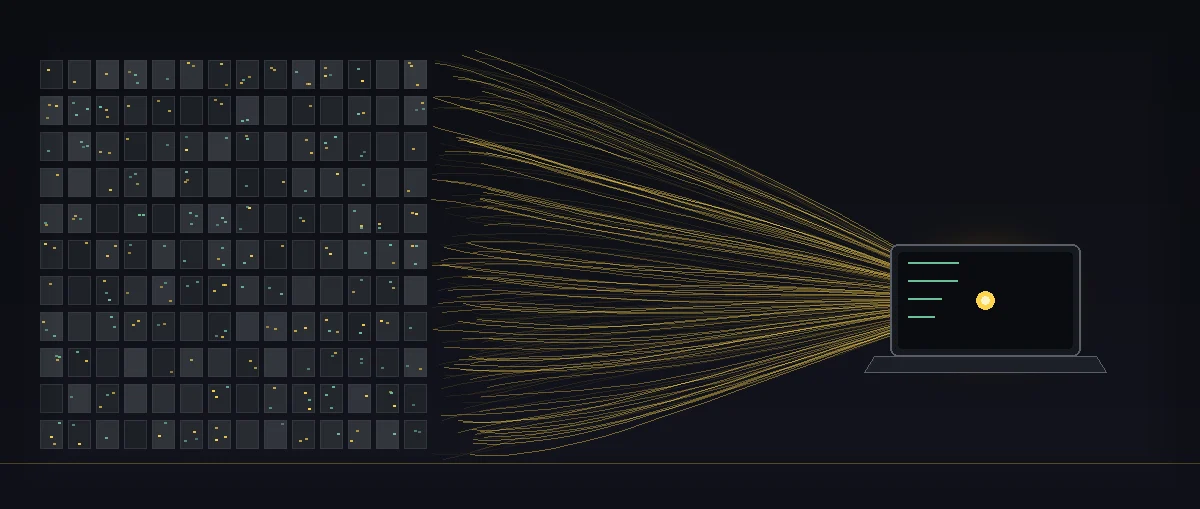
A friend handed me two provocations that sound like science fiction and, taken literally, are. First: compress hundreds of terabytes of AI training data — millions of times over — down to about one kilobyte. Second: make a single CPU-only laptop the equal of a gigawatt of datacenter AI compute. Taken literally, both proposals exceed information or computation limits. A narrower question is useful: how much task-specific capability can be moved onto a laptop?
In twelve years around data centers I have learned to respect physical limits — a busbar carries what it carries, a chiller rejects what it rejects. Information and computation have limits every bit as hard. But those limits govern bytes and joules. They say almost nothing about the thing we actually care about: capability. Distillation, retrieval, and specialized tools can move some useful capabilities onto smaller hardware. This is a map of both walls, the real research climbing them, and a practical pipeline for improving a local model on your own tasks and testing where it still falls short.
The verdict, up front
Literally shrinking arbitrary data to 1 KB, or running a gigawatt of floating-point operations on a laptop, is physically impossible. But compressing the capability those things encode — and migrating it onto small hardware — is already happening at ratios that read like typos. The right question is not “1 KB or 1 GW.” It is capability density: how much usable intelligence fits in a byte and a watt.
Wall One: the information limit
Claude Shannon gave us the floor for lossless compression: you cannot, on average, encode a source in fewer bits than its entropy. Redundant, structured data — language, images, model weights — has entropy far below its raw size, which is exactly why compression works at all. But there is a deeper limit named for Andrey Kolmogorov: the Kolmogorov complexity of a string is the length of the shortest program that outputs it. That is the true compressed size, and its punchline is brutal: almost every long string is incompressible. There simply are not enough short programs to name every long file.
So “300 TB → 1 KB” is only possible for data that is itself the output of a roughly 1-KB program. Real training corpora are redundant, but they are not 1-KB-generatable. Against arbitrary data, the wall is absolute. The escape is to stop trying to keep the data and instead keep the ability the data taught — because a trained model is not a copy of its corpus. It is a lossy, generative summary of the corpus's regularities. Learning, formally, is compression.
How far capability actually compresses
Here the numbers get genuinely absurd — and they are shipping, not speculative. Knowledge distillation trains a small “student” to mimic a large teacher: DistilBERT keeps ~97% of BERT-base on language understanding with 40% fewer parameters (66M vs 110M) and runs ~60% faster (Sanh et al., 2019). Dataset distillation goes further, synthesizing a tiny set of artificial examples that train a model almost as well as the full dataset: on ImageNet-1K, 50 synthetic images per class (4.2% of the data) trains to within ~5.9% accuracy of full-dataset training (NeurIPS 2024). The honest caveat the hype omits: distilled sets still trail full data, need soft probabilistic labels to scale, and often cost more compute to distill than they save.
The densest proven result is at the bit level. Microsoft's BitNet b1.58 stores every weight as one of three values — −1, 0, +1 — which is log₂(3) ≈ 1.58 bits per weight. Trained that way from scratch, it matches a full-precision LLaMA of the same model size and token budget on perplexity and end-task accuracy; a 70B version ran 4.1× faster, delivered 8.9× the throughput, used 7.16× less memory, and cut matmul energy 71.4× on 7 nm silicon (Microsoft, arXiv:2402.17764). The load-bearing caveat: this is a native low-bit model trained ternary. You cannot post-quantize an existing FP16 model to 1.58 bits and keep the quality — the crossover only holds when the model learns in ternary from the start. The first shipped weights, bitnet-b1.58-2B-4T (2B params, 4T tokens), landed in April 2025. That is the highest capability-per-bit humanity has demonstrated.
And the data need not be stored as data at all. Implicit neural representations (the COIN line of work) throw away the pixels and keep a small network that regenerates them — the image becomes a tiny function, beating JPEG at low bitrates. Hyperdimensional computing superposes many items into a single high-dimensional vector and pulls them back out approximately — the principled version of “compress a knowledge base into one vector.” And Matryoshka embeddings (now inside OpenAI's text-embedding models) pack coarse-to-fine meaning so a truncated prefix is still a good vector, cutting storage up to 14× at equal accuracy. None of these hit 1 KB for rich signals — but every one moves the floor.
Put those together and you get the honest “millions×” number — but of capability, not bytes, and you have to show the arithmetic or it becomes a lie. Take a frontier-class 70-billion-parameter model trained on roughly 15 trillion tokens — on the order of ~15–20 TB of text. Its learned weights are 140 GB at FP16: a ~100–150× lossy collapse of the corpus into capability. That ~100–150× is the solid, defensible number. Quantize to INT8 (70 GB) and it approaches ~250×; push to BitNet's 1.58 bits (~14 GB) and this 70B lands near ~1,300×. The eye-popping ~4,000× you see quoted is real arithmetic but a different model — an 8B trained on the same corpus, at 4-bit, is only ~4–5 GB against ~15–20 TB. Legitimate, but you swapped the model mid-sentence, so treat ~4,000× as illustrative, not a cited constant. And note the deeper point: unlike a ZIP, none of this can reconstruct the training data. It is lossy compression of regularities, not bytes — never 1 KB for arbitrary data, but a genuinely staggering collapse of ability into a fraction of the space.
Wall Two: the thermodynamic limit
Now the second target. In 1961 Rolf Landauer proved that erasing one bit of information irreversibly must dissipate at least kT·ln2 ≈ 2.8×10⁻²¹ joules (2.8 zJ) of heat at 300 K — about 0.018 eV. It is not an engineering hurdle; it is thermodynamics, and it was directly confirmed in 2012 with a single colloidal particle in a double-well trap (Bérut et al., Nature 2012). A 1 GW datacenter performs some vast number of irreversible operations per second. To match that operation rate inside a laptop's ~50 W envelope would mean doing roughly 20 million times more work per joule than the datacenter. On today's silicon, which already burns 10⁴–10⁶× the Landauer minimum per bit (arXiv:2312.08595), that is flatly impossible.
Inference is not training
The gigawatt buys the training. Running the finished model — inference — costs a rounding error by comparison. That is why a capability which cost a datacenter to create can already run on your laptop. The datacenter never moves into your PC; the capability does.
Changing the physics of the operation
The only way past a thermodynamic floor is to change what the operation costs. Four frontiers try, each real, none finished:
- Reversible computing (Landauer, then Bennett, Fredkin, Toffoli): compute without erasing bits and the Landauer floor no longer applies — IEEE Spectrum frames a potential ~4,000× efficiency upside. Decades-old theory; unsolved at scale.
- Analog in-memory computing: memristor crossbars do a whole matrix-multiply — the core AI operation — in one physical step via Ohm's and Kirchhoff's laws, with no data movement. Recent devices report tens of TOPS per watt and ~85× efficiency gains for the right workloads.
- Photonic and neuromorphic: multiply with light; or compute with brain-like spikes. Intel's Hala Point (Loihi 2) packs 1.15B neurons across 140,544 cores in ≤2,600 W and shows up to ~100× less energy on sparse, event-driven workloads (Intel, 2024) — but it is a research machine, not a general-purpose LLM box. The existence proof is your own head: roughly 20 watts of general intelligence, six orders of magnitude below a training cluster.
- Thermodynamic computing (Extropic, Normal Computing): stop fighting thermal noise and sample from it, targeting generative workloads with an aspirational ~10,000× energy claim (Extropic) — a prototype/startup figure that “deserves scrutiny,” not a shipped benchmark. Print it as a bet, not a fact.
| Substrate | How it computes | Efficiency vs silicon | Maturity | Hard part |
|---|---|---|---|---|
| Reversible / adiabatic | Never erase bits → escape the Landauer tax | ~4,000× (theoretical) | Lab / theory | Practical reversible logic at scale |
| Analog in-memory | Memristor crossbar does matmul in physics | ~85× measured | Research silicon | Precision, noise, programming drift |
| Photonic | Multiply-accumulate with interference of light | High (workload-specific) | Startups shipping | Optical nonlinearity, integration |
| Neuromorphic | Event-driven spikes; memory + compute fused | >100× on fit tasks | Research (Loihi 2) | Programming model; training SNNs |
| Thermodynamic | Harness thermal noise as the computation | ~10,000× (claimed) | Early / simulation | Unproven at product scale |
| Human brain (reference) | ~86B neurons, massively parallel, sparse | ~10⁶× (existence proof) | Shipping for 300k years | We cannot build one yet |
The lever that actually reaches the laptop
There is a fifth path, and it is the one that quietly wins. The compute needed to reach a given capability keeps falling as algorithms improve. Hernandez & Brown found the compute to hit AlexNet-level accuracy dropped 44× between 2012 and 2019 — a doubling of efficiency every ~16 months, faster than Moore's Law (arXiv:2005.04305). Epoch AI later put a tighter number on language models across 231 models: the compute to reach a fixed capability halves roughly every 8 months (95% CI 5–14 months) (Epoch AI). That is the real mechanism by which yesterday's gigawatt capability lands on tomorrow's laptop — not by cramming a power plant into the case, but by needing far less of it for the same mind. It is also the most reliable lever here: the exotic hardware below is promise; this is measured, repeatedly.
The reframe: capability density
Put the two walls together and a single idea falls out. Store the generator, not the data (Kolmogorov, implicit representations, generative priors): the north star is not a 1-KB file but a small program plus a shared prior that reconstructs what you need. And exploit physics, not FLOPs (analog, reversible, neuromorphic): stop paying a Landauer tax you can avoid. The honest metric is neither bytes nor operations. It is Capability Density — usable task-ability per byte and per watt — and the Compression Horizon: for a given body of knowledge, the smallest generator that reproduces its useful capability. Kolmogorov bounds it from below, but for real, redundant knowledge that horizon sits dramatically closer than the raw size suggests.
Definition — Capability Density
The usable task-capability delivered per unit of storage and per unit of power: informally, CD ≈ (task capability) / (bytes × watts). It replaces the two vanity metrics — raw bytes and raw FLOPs — that the “1 KB / 1 GW” dream fixates on. Every advance above raises CD: distillation and 1.58-bit quantization shrink the bytes; analog, neuromorphic, and algorithmic efficiency shrink the watts. The Compression Horizon is CD's ceiling for a given body of knowledge — the smallest generator that still reproduces its useful capability, bounded below by Kolmogorov but, for real redundant knowledge, dramatically closer than the raw size.
From default model to domain genius
Which brings us home to something you can build this week. A ~7B model on a CPU-only PC will never equal a frontier system — that is physics, not defeatism. But it can become a genuinely sharp expert on your data and your tasks, often indistinguishable from “very smart” for the work you actually do. The gains form a pipeline, ordered by return on effort. The two highest-leverage stages — retrieval and tools — require no training at all.
First, the honest ceiling: what fits on your machine
Before the pipeline, the hard constraint. A model must fit in memory to run at usable speed, and the rule of thumb is simple: usable RAM/VRAM (GB) ≈ params(B) × bits ÷ 8 plus KV-cache overhead — so a 4-bit (Q4) model costs about 0.5 GB per 1 billion parameters. That single line tells you exactly how far you can go.
| Your hardware | Max model (Q4) | Realistic speed | Notes |
|---|---|---|---|
| 16 GB laptop / M-series | 7B–13B | 7B: ~12–18 tok/s (older) → 60–80 tok/s (M4 Full access); 13B: ~6–50 tok/s | The everyday sweet spot; unified memory helps Apple silicon |
| 24–32 GB / single 24GB GPU | up to ~32B | tens of tok/s | Comfortable for coder + RAG agents |
| 70B at Q4 | needs ~43–45 GB | dual RTX 3090 (48GB): ~16–21 tok/s; CPU-offload: ~2–4 tok/s | Does not fit any single consumer GPU; needs 2 cards or offload |
| CPU-only, 32–64 GB RAM | 7B–34B | a few–low-tens tok/s | Works; slower, but RAG + tools still feel smart |
So the “max” on a normal laptop today is a ~13B model at 4-bit, or ~32B on a 24–32 GB machine. Everything below is about making that model punch far above its size — because raw size was never the lever that mattered most. Sources: Apple-silicon + consumer-GPU local-LLM benchmarks, 2026 (EaseCloud).
Concretely: pick the strongest base your RAM allows and quantize it to fit; write a real system prompt; then — the biggest single lift — add retrieval-augmented generation so the model answers from your documents instead of hallucinating; give it tools so it can act, not just chat; and only then reach for LoRA fine-tuning (which wants a GPU) to bake in voice and domain reflexes, ideally distilling from a stronger teacher. Retrieval plus tools is where a laptop captures roughly four-fifths of the felt intelligence for a fifth of the work — no training required.
| # | Stage | What you need | Cost | Time | ROI | Main risk |
|---|---|---|---|---|---|---|
| 1 | Base model | Pick strongest open weight that fits (Qwen3 / DeepSeek / Mistral, Apache/MIT) | free | minutes | Foundation | License traps (Llama community ≠ open); over-sizing |
| 2 | Quantize | GGUF Q4_K_M (llama.cpp / Ollama); AWQ·GPTQ on GPU; MLX on Mac | free | minutes | High | Below Q4 breaks: Q3 loses reasoning, Q2 collapses |
| 3 | System prompt / few-shot | A real role prompt + a few worked examples | ~free (tokens) | hours | High, instant | Brittleness; long prompts cost context + latency |
| 4 | RAG / retrieval | Embedder + vector store + chunking over your docs | modest ($18–45K at scale; ~free locally) | days | Highest | Retrieval/chunking quality dominates; added latency |
| 5 | Tools + agent (MCP) | Function-calling / MCP: file R/W, shell, APIs, loop | medium | days | Very high | Tool-selection errors, error cascades, tool-injection security |
| 6 | Fine-tune (QLoRA) | One 48GB GPU + a clean Q&A dataset (ideally distilled from a stronger teacher) | ~$15–30/run compute; $5–15K all-in | ~24h/run + data prep | Situational | Catastrophic forgetting; stale baked knowledge; data prep dominates |
| 7 | Memory / continual | Episodic memory + reflection across sessions | modest | days | Compounding | Memory drift; retrieval of stale facts |
| 8 | Orchestrate / verify | Self-consistency, critic, ensembles | compute (N× calls) | days | High | Cost multiplies; diminishing returns |
| 9 | Eval loop | A held-out task set you actually score against | modest | ongoing | Directional | Gaming your own metric |
The rule that saves the most money: RAG for knowledge, fine-tuning for behavior. If the model lacks facts (that also change), reach for retrieval — it stays fresh and cites its source, and below ~100K interactions/month it is usually cheaper than fine-tuning. Only reach for QLoRA when prompting + RAG + tools still leave a style, format, or reflex gap that production data reveals. And a sobering frontier marker: even the best model scores only 57.77% on the hardest agentic-tool benchmark (MCPVerse) — tools multiply capability, but orchestrating them reliably is still unsolved.
A concrete recipe (what actually works on a laptop)
The pipeline is not abstract. Here is the minimal, no-GPU path — roughly the stack behind this site's own local tooling:
- Runtime + model: install ollama, then
ollama pull qwen2.5(orqwen2.5-coderfor code). Ollama is the engine; qwen is one model it serves. - Persistent chat: wrap it so conversations are saved and resumable rather than lost on exit — the difference between
ollama run(ephemeral) and a thin logging wrapper that records each turn. - Retrieval (the big lift): embed your notes/docs with an embedding model (e.g.
nomic-embed-text), store the vectors, and at query time fetch the top matches and inject them into the prompt. Now the model answers from your knowledge, not its training-set average. - Tools / agent: expose file-read/write and shell to the model via function-calling and loop: propose → act → observe → repeat. That is what turns a chatbot into a coding agent.
- Only then consider LoRA fine-tuning (needs a GPU) to bake in your voice and domain — ideally on question/answer pairs distilled from a stronger teacher model.
Stages 1–4 need zero training and run on a CPU-only machine. In practice they deliver the bulk of the felt intelligence: a model that is grounded, current, and able to act on your actual material.
Which tool for which job (Claude, ChatGPT, Ollama, Gemini)
The stages above are provider-agnostic, but each ecosystem has a sweet spot — and the honest trick is to match the tool to the stage, not to pick one and force everything through it.
| Tool | Best at | The trick | Where it fits |
|---|---|---|---|
| Ollama (local) | Running Q4 GGUF models on your own hardware, offline & private | ollama pull qwen3; obey the 0.5 GB/1B rule; add an embedder (nomic-embed-text) for RAG | Stages 1–5, fully local — the backbone of a private assistant |
| Claude | Long-context reasoning + MCP-native tool/agent loops | Wire tools via MCP so it can read files, run code, and iterate; lean on the large context for whole-repo work | Stages 3&5 — the agentic layer + hardest reasoning |
| ChatGPT | Function-calling + custom GPTs + a broad plugin/tool surface | Define JSON function schemas for your tools; package a domain assistant as a custom GPT with instructions + files | Stages 3–5 — quick tool-using assistants |
| Gemini | Very long context + native web grounding + multimodal | Feed large document sets directly; use grounding to keep answers current without a self-hosted RAG store | Stage 4 alternative — retrieval-lite over huge inputs |
A realistic build mixes them: Ollama for the private, always-on local model + RAG over your own files; a frontier API (Claude / ChatGPT / Gemini) for the hard reasoning, the agent loop, or as the teacher whose answers you distill into QLoRA data for the local model. Local for privacy and cost; frontier for the ceiling.
Myths versus reality
| Claim | Verdict | Why |
|---|---|---|
| Arbitrary 300 TB → 1 KB, lossless | Impossible | Kolmogorov / Shannon: cannot beat information content |
| A corpus's capability → sub-GB (0.4 GB @1.58-bit) | Proven | BitNet b1.58 |
| A dataset → a few synthetic training samples | Frontier | Dataset distillation, with real accuracy caveats |
| A laptop performs 1 GW of FLOPs | Impossible | Landauer floor + power budget |
| A laptop runs a 1-GW-trained capability | Proven | Inference « training; quantization |
| That capability keeps getting cheaper to reach | Proven | Algorithmic efficiency, ~8-month halving |
| Orders-of-magnitude denser compute (analog/neuromorphic) | Frontier | Memristor TOPS/W; Loihi 2 >100× |
| Compute far below today's energy/op (reversible/thermo) | Speculative | Bennett; Extropic/Normal — early/simulation |
The literal dream lives on the impossible side of that table. But look at what sits on the proven side: the knowledge of a trillion-token corpus at 1.58 bits a weight, a gigawatt-trained mind running on the machine on your desk, and the compute for any given capability halving twice a year. We were never going to shrink the datacenter into the laptop. We are, instead, watching the mind of the datacenter walk in on its own — and there is real, sober physics telling us how much further it can go.
The compression horizon is not a wall. It is a coastline we are still mapping — and every year the tide of capability density comes in a little further.
Frequently asked questions
What is the real maximum — how far can you compress?
For arbitrary/lossless data: essentially zero headroom — Shannon and Kolmogorov complexity mean most long files are incompressible, so 300 TB→1 KB is impossible. For capability, the demonstrated ceilings are concrete: weights down to 1.58 bits at full quality (BitNet, if trained ternary from scratch); a corpus→weights collapse of ~100–150× (solid) rising to ~1,300× at 1.58-bit; distillation keeping ~97% of a model at 40% of the size. The often-quoted “~4,000×” is illustrative arithmetic (a small model at 4-bit), not a single measured constant.
Can a laptop equal a 1 GW datacenter — and what would it take?
In raw FLOPs, no: the Landauer floor (2.8 zJ/bit) plus a ~7-orders power gap forbid it. What a laptop can do, and the conditions to get there: (1) run (not train) the model — inference costs ~2P vs ~6P FLOPs/token; (2) fit it — ~13B at Q4 on a 16 GB machine, ~32B on 24–32 GB; (3) ride algorithmic efficiency — the compute for a fixed capability halves every ~8 months. You never move the datacenter in; you run the capability it trained.
How do I make my local AI genuinely smart — concretely?
Follow the ROI order, and know the pass/fail bar at each step: (1) strongest open model that fits (Qwen3/DeepSeek, Apache/MIT); (2) quantize to Q4_K_M — never below Q4 (Q3 loses reasoning, Q2 collapses); (3) a real system prompt + few-shot examples (reported 30–60% quality lift, ~free); (4) RAG over your own docs — the biggest single lift, and the fix whenever facts are missing or change; (5) tool/agent loops so it can act. Only (6) QLoRA fine-tune (one 48 GB GPU, ~24h, ~$15–30/run) when a style/format gap remains. Stages 1–5 need no training. Rule: RAG for knowledge, fine-tune for behavior.
Sources & further reading
Confidence tags: [proven] primary/peer-reviewed; [reported] secondary benchmark or vendor figure; [frontier] early research; [claim] aspirational, unverified.
- Ma, Wang et al., The Era of 1-bit LLMs (BitNet b1.58), 2024 — arXiv:2402.17764; microsoft/BitNet · bitnet.cpp CPU inference (Microsoft Research) [proven]
- Hernandez & Brown, Measuring the Algorithmic Efficiency of Neural Networks, 2020 — arXiv:2005.04305; Epoch AI, Algorithmic progress in language models — epoch.ai (arXiv:2403.05812) [proven]
- Sanh et al., DistilBERT, 2019 — arXiv:1910.01108; Are Large-scale Soft Labels Necessary for Dataset Distillation?, NeurIPS 2024 — PDF [proven]
- Dupont et al., COIN: Compression with Implicit Neural Representations, 2021 — arXiv:2103.03123; Kusupati et al., Matryoshka Representation Learning, NeurIPS 2022 — arXiv:2205.13147 [proven]
- Kanerva / Kleyko et al., A Survey on Hyperdimensional Computing (VSA), Part I — ACM Computing Surveys [proven]
- Bérut, Lutz et al., Experimental verification of Landauer's principle, Nature 2012 — nature10872; Limits to Energy Efficiency of CMOS — arXiv:2312.08595 [proven]
- Intel, Hala Point / Loihi 2 — Intel Newsroom, 2024 [frontier]
- Yin et al., MCPVerse: agentic tool-use benchmark, 2025 — arXiv:2508.16260 [proven]; Dettmers et al., QLoRA, 2023 — arXiv:2305.14314 [proven]
- Extropic, Thermodynamic Computing: From Zero to One — extropic.ai [claim]